
By Carroll Walker September 29, 2026
A dispensary owner may be able to operate a genuinely separate hemp/CBD business that is potentially eligible for card processing, but creating another LLC is not enough. Separate CBD entity cannabis card processing requires lawful products, truthful underwriting, distinct inventory, banking, checkout, accounting and settlement flows, with marijuana transactions kept completely outside the hemp merchant account.
For a cannabis operator, the practical question is not whether a second company can be registered with a secretary of state. It is whether the hemp/CBD operation is a real business that an acquiring bank can independently understand, underwrite and monitor.
As of September 29, 2026, federal law still defines hemp using a concentration of no more than 0.3% delta-9 tetrahydrocannabinol on a dry-weight basis. That statutory definition changes on November 12, 2026, when an amendment enacted in P.L. 119-37 takes effect and moves the definition to total tetrahydrocannabinols, expressly including THCA, while adding important exclusions for certain cannabinoid products.
| Question | Practical answer |
| Can a dispensary owner form a separate CBD company? | Potentially, yes. Common ownership should be disclosed and does not itself make the hemp operation card-eligible or ineligible. |
| Does another LLC or EIN solve the payment problem? | No. Underwriting follows the actual seller, products, checkout, bank settlement and business activity. |
| Can marijuana sales use the hemp merchant account? | They should not. Doing so contradicts the basis on which the hemp merchant was underwritten and may be treated as undisclosed or laundered transaction activity. |
| Are all products below 0.3% delta-9 THC automatically lawful? | No. Federal hemp classification, FDA product law, state law and the November 12, 2026 change are separate questions. |
| Can hemp/CBD businesses receive ordinary card-processing approval automatically? | No. Approval depends on product type, jurisdiction, acquirer policy, processor policy, website review and ongoing compliance. |
| Should the two companies have separate banking and books? | A defensible dual-entity model normally makes revenue, settlements, refunds, inventory and accounting independently traceable. |
Hemp Side vs. Marijuana Side: What Actually Changes for Payments?
A genuine hemp/CBD entity and a marijuana dispensary may have the same ultimate owner while still operating as distinct businesses. The challenge is proving that distinction with more than formation documents.
| Issue | Separate Hemp/CBD Entity | Marijuana/Plant-Touching Entity |
| Federal classification | Products must satisfy the operative federal hemp rules and other applicable federal law | Treatment depends on the product and current Controlled Substances Act rules |
| Card-processing potential | Potentially available, subject to acquiring and product underwriting | Conventional card acceptance remains heavily constrained and should not be routed through the hemp MID |
| Bank account | Should correspond to the disclosed hemp/CBD business | Should remain within the marijuana business’s approved banking environment |
| Inventory | Independently traceable hemp/CBD SKUs | State-regulated marijuana inventory |
| Product review | COAs, labels, ingredients, sourcing, website claims and shipping footprint | Cannabis licensing, inventory and other marijuana-specific controls |
| Checkout | Hemp/CBD products represented by the approved seller | Must not pass through the hemp seller’s MID |
| Settlement | Traceable to the hemp entity’s approved account | Kept within the marijuana entity’s approved financial channels |
| Monitoring | Website, COA, product and transaction review may continue | MRB banking and regulatory monitoring may continue |
A separate hemp merchant account does not remove the payment restrictions affecting the marijuana operation. Keeping the two activities distinct starts with understanding how high-risk payment processing differs for marijuana merchants and ensuring that the hemp MID is used only for the business activity actually disclosed and approved.
The Federal Legal Line Is More Complicated Than “0.3% THC”
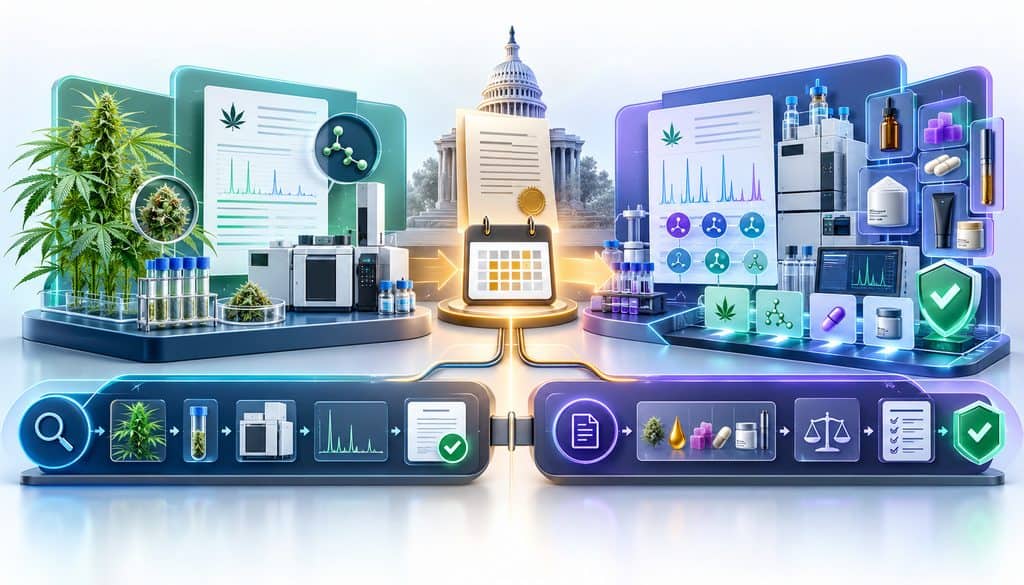
The phrase “under 0.3% THC” is often used too loosely.
The rule actually in effect on September 29, 2026
The current federal statutory definition in 7 U.S.C. §1639o defines hemp as Cannabis sativa L. and covers parts, derivatives, extracts, cannabinoids and related substances with a delta-9 THC concentration of not more than 0.3% on a dry-weight basis.
That is the current statutory definition on the publication date of this article.
It should not be confused with USDA’s hemp-production testing requirements.
USDA already uses total-THC concepts for production testing
USDA requires hemp samples subject to its production-testing framework to be tested using post-decarboxylation or another similarly reliable method that accounts for the potential conversion of THCA into delta-9 THC.
USDA describes the testing result as total THC derived from THC plus the potential THC contribution from THCA.
That means two different rules are operating in different contexts:
- the current statutory hemp definition still refers to 0.3% delta-9 THC on a dry-weight basis; and
- USDA production compliance testing already accounts for THCA conversion when evaluating a crop.
Those concepts should not be merged into one rule.
That statutory definition should not be confused with hemp-production testing. USDA’s current hemp laboratory testing guidelines require post-decarboxylation or similarly reliable testing that accounts for the potential conversion of THCA into THC and reports total available THC on a dry-weight basis.
What Changes on November 12, 2026?
Congress enacted a significant amendment in P.L. 119-37 on November 12, 2025. The amendment becomes effective 365 days later—November 12, 2026.
The future definition changes “hemp” from the present delta-9-only formulation to a standard based on total tetrahydrocannabinols, including tetrahydrocannabinolic acid, or THCA, at no more than 0.3% on a dry-weight basis.
The amendment also adds exclusions addressing certain hemp-derived cannabinoid products, including specified cannabinoids synthesized or manufactured outside the plant.
That date matters enormously for separate CBD entity cannabis card processing.
A merchant should not obtain an approval in September or October 2026, keep the same SKU catalog indefinitely and assume that products qualifying under the pre-November definition remain within the amended definition after November 12.
A sensible compliance review should include:
- Every active SKU.
- Current COAs.
- Delta-9 THC.
- THCA and total-THC information where relevant.
- Whether cannabinoids are naturally occurring, converted, synthesized or otherwise manufactured.
- The product’s state-by-state sales footprint.
- Any processor or acquirer restrictions triggered by the statutory change.
“Hemp” Under the CSA Does Not Mean Every CBD Product Is Lawful to Sell
This is one of the most important distinctions in the article.
The 2018 Farm Bill changed the federal controlled-substance treatment of qualifying hemp, but it did not eliminate FDA’s authority over foods, dietary supplements, drugs, cosmetics and other FDA-regulated products.
FDA continues to state that the applicable rules depend on the type of CBD product being marketed.
For example, FDA’s current public position states that CBD generally cannot simply be added to conventional food or marketed as a dietary supplement under the existing FD&C Act framework.
That means a COA showing an acceptable cannabinoid result answers only one part of the analysis.
A merchant may still face questions involving:
- food ingredients;
- dietary-supplement positioning;
- disease or therapeutic claims;
- drug status;
- cosmetics requirements;
- labeling;
- state product restrictions; and
- age or shipping controls.
FDA itself warns against the misconception that the Farm Bill made every hemp-derived consumer product automatically lawful.
Before adding ingestible CBD products, merchants should review the FDA’s current regulation of cannabis and cannabis-derived products instead of relying only on the federal hemp definition.
Separate CBD Entity Cannabis Card Processing Is Still Subject to Underwriting
A product can satisfy one legal definition without creating any entitlement to card acceptance.
There is no federal statute requiring an acquiring bank or payment processor to approve a hemp/CBD merchant simply because the merchant believes its products qualify as hemp.
The underwriting analysis may consider:
- Federal product classification.
- FDA requirements.
- State law.
- The merchant’s destination states.
- Product type.
- Marketing and medical claims.
- Ownership.
- Related marijuana operations.
- Fulfillment.
- COAs and sourcing.
- Acquirer policy.
- Processor policy.
- Transaction-monitoring requirements.
That is why “potentially eligible for card acquiring” is more accurate than saying “CBD is legal, so cards are allowed.”
CBD operators should also understand the practical differences between high-risk merchant accounts and alternative cannabis payment arrangements, because the availability of a payment method does not mean every cannabinoid product or related marijuana activity has been approved for that channel.
Why Underwriters Are Concerned About Blended Marijuana and CBD Businesses
The central underwriting question is simple:
What exactly did the cardholder buy from the merchant whose name appears in the application?
A blended operation can make that answer difficult.
For example, one combined checkout may contain:
- ordinary CBD products;
- state-licensed marijuana;
- THCA products;
- delta-8 products;
- products subject to state intoxicating-hemp restrictions;
- ingestibles raising FDA questions; or
- products not disclosed during underwriting.
If the same MID processes everything, the acquiring relationship can no longer reliably distinguish the business it approved from other activities.
This is also why simply creating “CBD Holdings LLC” does not cure the problem. If the dispensary’s marijuana transactions still enter the CBD merchant account, the economic reality contradicts the application.
When related entities share staff, systems, or locations, consistent compliance controls for cannabis transactions become especially important because inventory records, payment records, bank deposits, and the identified seller should remain reconcilable to the correct business.
What a True Dual Entity Dispensary Structure Requires
A credible structure focuses on operational separation, not just paperwork.
A genuine hemp company commonly needs its own supportable business identity, which may include:
- Separate legal entity: The entity named in the merchant application should actually sell the hemp/CBD products.
- Separate EIN: Tax identity should correspond with the legal seller where a separate entity is used.
- Clear ownership records: Common ownership should be disclosed when requested rather than hidden.
- Separate operating bank account: Hemp card settlements should enter the bank account disclosed for the hemp merchant.
- Separate merchant account and MID: The CBD account should process only activity approved for that account.
- Separate bookkeeping ledger: Revenue, fees, refunds, inventory and expenses should be traceable.
- Distinct inventory records: Hemp/CBD SKUs should not become indistinguishable from marijuana inventory.
- Supplier documentation: Purchase invoices, manufacturers and sourcing records should correspond to the approved products.
- Separate or reliably segregated checkout.
- Clear seller-of-record disclosures.
- Separate settlement reporting.
- Entity-specific refund records.
- Appropriate tax reporting.
- Documented intercompany transactions.
- Fulfillment controls identifying which entity shipped or delivered the order.
The fact that the same person owns both companies does not automatically invalidate separate CBD entity cannabis card processing. But the relationship should be transparent enough that an underwriter does not discover an undisclosed marijuana connection later.
Separate Website, Checkout and POS: Where Structures Commonly Break Down
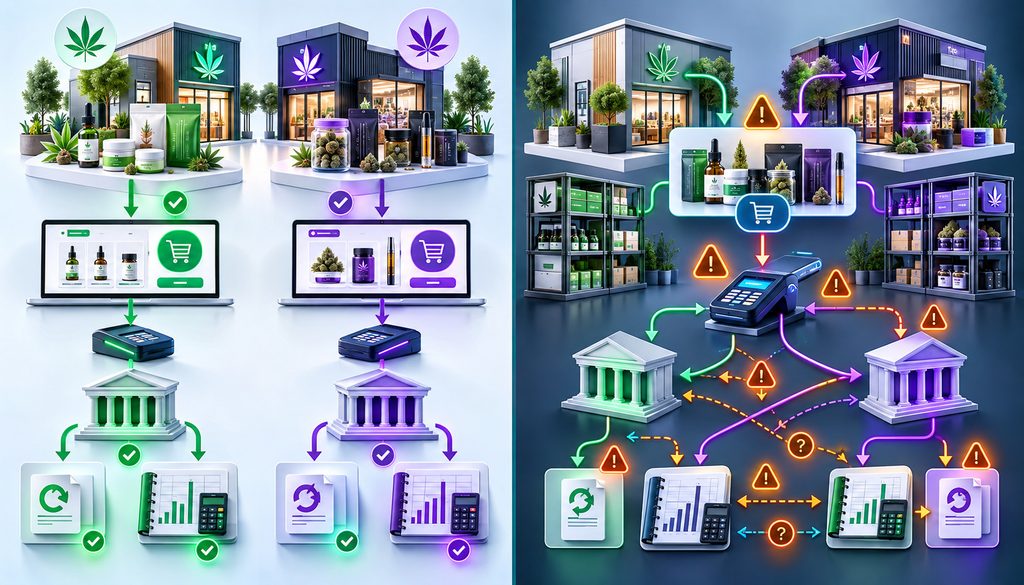
A sophisticated organizational chart cannot repair a mixed transaction flow.
One mixed shopping cart
A customer should not be able to place a dispensary marijuana product and a hemp product into one card-funded cart that settles through the CBD MID.
The card transaction must correspond to the merchant and products approved for that merchant relationship.
Using the hemp MID at the dispensary register
A merchant account approved for Hemp Entity A should not quietly become the card terminal for Marijuana Entity B.
Even if the companies have identical ownership, the transaction being submitted has changed.
One undifferentiated POS catalog
Using the same software platform is not necessarily the same thing as mixing merchants.
Some software can support separate entities, stores, inventory catalogs, merchant credentials and settlement reporting. The issue is whether those controls genuinely preserve the legal seller and payment path.
Cross-entity refunds
If Hemp Entity A processed the original transaction, a refund should normally remain traceable to Entity A’s transaction history.
Using Entity B to reimburse customers can create reconciliation and underwriting problems.
Shared domains
Two businesses do not necessarily need completely unrelated internet infrastructure. But the website must not leave a cardholder or underwriter guessing which company is selling the product.
At minimum, evaluate:
- merchant name;
- terms and conditions;
- privacy disclosures;
- refund policy;
- contact details;
- product pages;
- checkout;
- receipt;
- descriptor; and
- fulfillment records.
All should support the same seller-of-record story.
Sharing Back-Office Infrastructure Is Different From Sharing Transactions
A legitimate dual-entity business may share certain resources.
For example, both companies might use:
- the same physical office;
- the same CPA;
- related management;
- common payroll administration;
- the same ecommerce software vendor;
- the same warehouse building; or
- some employees.
None of those facts alone proves that the entities are improperly commingled.
The higher-risk issue is when shared infrastructure makes it impossible to determine which company owned the inventory, sold the product, received payment or issued the refund.
That distinction makes separate CBD entity cannabis card processing more understandable:
shared services may sometimes be supportable; shared or disguised transaction flows are a much more serious problem.
What COAs and Product Documents Will Underwriting Need?

A serious CBD merchant-account application should treat product review as a core part of underwriting.
Depending on the acquirer, product and jurisdiction, the file may need:
| Document or data point | Why it matters |
| Certificate of analysis | Shows laboratory results for the tested product or batch |
| Cannabinoid profile | Identifies measurable cannabinoids |
| Delta-9 THC result | Relevant to the current statutory hemp definition |
| THCA result | Relevant to USDA production testing and the coming statutory change |
| Total THC | Increasingly important for cannabinoid review |
| Batch/lot identifier | Helps connect the COA to actual inventory |
| Laboratory identity | Shows who performed the testing |
| Accreditation information | May be requested as part of product-risk review |
| Label | Lets the underwriter compare marketing with laboratory documentation |
| Ingredient list | Important for FDA/product-category review |
| Manufacturer | Establishes supply-chain source |
| Supplier invoices | Supports sourcing and commercial provenance |
| Hemp sourcing records | Helps document origin |
| State licenses/registrations | Required where applicable |
| Product photographs | Confirms merchandise being marketed |
| Product URLs | Allows live-site review |
| Destination states | Supports jurisdiction review |
| Shipping controls | Shows whether restricted destinations can be blocked |
| Refund policy | Part of merchant-risk review |
| Terms and conditions | Identifies the legal seller and transaction terms |
| Age controls | Relevant for products or jurisdictions requiring them |
| Marketing claims | Helps identify drug/therapeutic-claim risk |
Do not assume that a COA submitted once at account opening will satisfy every future review.
Products and batches change. Acquirers may request updated laboratory documentation when inventory, formulation or product URLs change.
There is also no responsible basis for claiming that every processor requires a COA to be “30 days old,” “90 days old” or any other universal period unless the specific acquirer states that requirement.
Delta-8, THCA and Converted Cannabinoids Need Separate Review
An operator should not automatically put every hemp-derived cannabinoid into a standard CBD underwriting package.
FDA has specifically expressed concerns about delta-8 THC products, including their psychoactive effects, safety issues and manufacturing methods.
THCA also requires careful treatment.
For federally regulated hemp production, USDA already requires testing methodologies that consider THCA’s potential conversion into delta-9 THC.
And beginning November 12, 2026, the amended statutory hemp definition itself expressly refers to total tetrahydrocannabinols, including THCA.
The appropriate compliance question is therefore not:
“Is THCA federally legal?”
It is:
“How is this specific product classified under the federal rule applicable on the transaction date, the law of the relevant state, FDA rules where applicable, and the underwriting policy of the acquiring institution?”
The same approach should be used for delta-8, converted cannabinoids and synthesized cannabinoids.
A nationwide “legal/illegal” chart quickly becomes stale because states may regulate manufacturing, potency, age restrictions, retail sale and shipping differently.
Banking Separation and the FinCEN Marijuana Guidance
The marijuana company’s banking relationship operates in a different compliance environment from an ordinary hemp operation.
FinCEN’s marijuana banking guidance, FIN-2014-G001, was issued on February 14, 2014 and remains publicly maintained by FinCEN. It explains BSA due-diligence and suspicious-activity-report expectations for financial institutions serving marijuana-related businesses.
Banks serving marijuana-related businesses operate under specialized BSA expectations. FinCEN’s marijuana-related business banking guidance, FIN-2014-G001 describes customer due diligence and the Marijuana Limited, Marijuana Priority, and Marijuana Termination SAR frameworks used by financial institutions.
Marijuana Limited SAR
FinCEN describes a Marijuana Limited filing framework when, based on customer due diligence, the financial institution reasonably believes the marijuana-related business does not implicate the enforcement priorities and state-law concerns described in the guidance.
Marijuana Priority SAR
Where the financial institution believes activity may implicate identified priorities or violate state law, the guidance describes a Marijuana Priority SAR with additional information.
Marijuana Termination SAR
When a financial institution terminates a relationship in connection with marijuana-related activity and its BSA/AML risk assessment, FinCEN describes Marijuana Termination reporting.
These are bank reporting classifications.
A dispensary does not obtain a “Marijuana Limited license” from FinCEN, and the filing of such a SAR does not make marijuana federally legal.
That distinction is essential whenever cannabis merchant banking is discussed.
Commingling Cannabis Revenue Can Put Both Relationships at Risk
Settlement segregation is one of the simplest ways to test whether the entities are really separate.
Consider this illustrative arrangement.
Hemp Entity A
- owns qualifying hemp inventory;
- sells the hemp products;
- operates the approved hemp checkout;
- processes through its approved MID; and
- receives settlement into its disclosed bank account.
Marijuana Entity B
- owns the marijuana inventory;
- conducts dispensary sales;
- uses its separately approved payment arrangements; and
- records its revenue in Entity B’s books.
If Entity B owes Entity A money for a legitimate shared expense, the companies can document the intercompany obligation and transfer.
What they should not do is disguise the origin of retail revenue.
Opening a CBD merchant account and intentionally submitting marijuana retail transactions through it can be viewed as transaction or merchant laundering because the card transaction presented to the acquiring system does not match the business underwritten for that MID.
After approval, changes in ownership, product mix, transaction volume, website content, or banking activity can create a very different risk profile from the one originally underwritten. Maintaining accurate records and responding to compliance requests are therefore part of reducing the risk of cannabis account freezes rather than merely application-stage tasks.
Bookkeeping, Separate Trades or Businesses and IRC §280E
The federal tax section needs special care in 2026 because the scheduling landscape changed.
IRC §280E applies by its text to a trade or business consisting of trafficking in controlled substances within Schedule I or Schedule II of the Controlled Substances Act when that trafficking is prohibited by federal or applicable state law.
Historically, IRS applied §280E to marijuana businesses while marijuana was in Schedule I. IRS also recognized that §280E does not eliminate properly calculated cost of goods sold.
The April 23, 2026 change matters
On April 23, 2026, DOJ and DEA announced an order placing two defined categories into Schedule III:
- FDA-approved products containing marijuana; and
- marijuana products subject to a qualifying state-issued medical marijuana license.
DOJ simultaneously initiated an expedited process concerning broader rescheduling.
DEA’s subsequent 2026 rescheduling proceeding makes an important distinction: broader marijuana outside that already-rescheduled category continues to be the subject of the Schedule I-to-Schedule III proceeding. A June 2026 DEA preliminary order described the “remainder of marijuana” as still located in Schedule I while the broader hearing proceeds.
Therefore, a 2026 article should not simply say “all marijuana remains Schedule I,” but it also should not say “marijuana is now Schedule III” without qualification.
What that means for §280E
Because §280E expressly refers to Schedule I and II substances, the tax consequences of the 2026 partial rescheduling need to be analyzed against the specific business activity and product involved.
This article should not attempt to determine an individual taxpayer’s treatment.
For the separate hemp business, the key principles remain:
- a genuinely lawful hemp trade or business is not transformed into a marijuana business simply because it has common ownership;
- creating a hemp LLC does not automatically move dispensary expenses into a non-§280E business;
- payroll, rent, management, marketing and other shared costs require supportable allocation;
- intercompany charges should have genuine economic substance;
- inventory and COGS records should be separately supportable; and
- current scheduling must be checked for the particular marijuana activity before reaching a §280E conclusion.
A CPA or tax attorney experienced in cannabis taxation should review the allocation before the entities file returns.
Application Path for a New Hemp/CBD Merchant Account
Separate CBD entity cannabis card processing works best when the operational separation exists before underwriting begins.
1. Define the actual product catalog
List every SKU the hemp company will sell.
Do not apply based on a generic “CBD store” description if the planned catalog includes THCA, delta-8, converted cannabinoids or other products requiring additional review.
2. Verify the federal rule that will apply when the product is sold
For transactions before November 12, 2026, begin with the current statutory hemp definition.
For products that will remain in inventory on or after November 12, re-test the analysis against the amended definition.
3. Review the destination states
Federal hemp classification does not override state restrictions.
Map where each product will be offered, shipped or delivered.
4. Review FDA product status
Determine whether the SKU is a food, cosmetic, drug, purported supplement or another regulated category and review associated claims.
5. Finish entity formation
Complete the entity’s ownership and governance records rather than relying on an incomplete filing.
6. Obtain its EIN and required registrations
Keep the name and address consistent across records.
7. Establish the hemp company’s bank account
The settlement account should correspond to the disclosed merchant.
8. Build separate inventory records
Each product should be traceable from supplier to sale.
9. Build the seller-of-record structure
Website terms, checkout, receipt and customer-facing merchant identity should identify the correct business.
10. Establish a separate merchant-payment path
Do not plan to split marijuana transactions from CBD transactions after they have already entered one MID.
11. Prepare the underwriting package
Include COAs, labels, sourcing records, product URLs, ownership information and applicable licenses.
12. Disclose related cannabis ownership
If the same owner controls a dispensary, answer underwriting questions accurately.
13. Complete requested website or product changes
Do not start processing first and seek approval later.
14. Process only approved activity
The products actually sold should stay within the scope represented during underwriting.
15. Maintain ongoing records
Refresh COAs, product files, shipping controls and ownership information as necessary.
How Long Does CBD Merchant Underwriting Take?
There is no credible universal underwriting timeline.
The review may depend on:
- ownership complexity;
- whether marijuana interests are related;
- SKU count;
- COAs;
- product chemistry;
- website changes;
- destination states;
- fulfillment;
- financial review;
- bank/acquirer review; and
- responses to compliance questions.
For that reason, this article should not promise “three-day,” “seven-day” or “two-week” approval as an industry standard.
Those may be individual provider experiences, but they are not universal legal or network deadlines.
Dual Entity Structure: Separation Checklist
| Area | Hemp/CBD Entity | Marijuana Entity | Separation test |
| Legal entity | Actual seller of hemp merchandise | Actual marijuana operator | Does the legal paperwork match real activity? |
| EIN | Corresponds to hemp entity | Corresponds to marijuana entity | Are applications tied to the right taxpayer? |
| Bank account | Receives hemp settlement | Holds marijuana revenue | Can deposits be traced to the originating business? |
| Merchant account | Approved hemp/CBD activity only | Separate approved channel | Are marijuana sales excluded from the hemp MID? |
| Inventory | Hemp/CBD catalog | Marijuana catalog | Can inventory ownership be independently proven? |
| Checkout | Hemp seller | Separate marijuana flow | Does each checkout identify one seller? |
| Website | Clearly identifies hemp merchant | Separate or clearly distinguished | Would a customer know which company is selling? |
| POS | Entity-specific configuration | Entity-specific configuration | Can one company’s products enter the other’s MID? |
| Bookkeeping | Separate ledger | Separate ledger | Are sales and expenses traceable? |
| Refunds | Refunds hemp transactions | Refunds marijuana transactions | Does the original merchant control the refund? |
| Supplier invoices | Hemp/CBD suppliers | Marijuana suppliers | Can the product source be demonstrated? |
| Tax records | Hemp activity | Marijuana activity | Do returns reconcile to the accounting records? |
| Intercompany transfers | Documented | Matching entry | Is there a genuine business purpose rather than hidden retail revenue? |
FAQ
Can a dispensary owner also own a CBD company that accepts credit cards?
Potentially. The CBD business must independently satisfy applicable product law and merchant underwriting. The relationship with the marijuana business should be accurately disclosed when required.
Does the CBD company need a separate LLC?
A separate entity is usually central to the structure described here, but an LLC alone is insufficient. Banking, inventory, accounting, seller identity and payment flows must support the separation.
Can the hemp and marijuana companies use the same bank account?
Doing so would make revenue and settlement segregation much harder to demonstrate. A genuinely separate business structure normally uses distinct accounts corresponding to the respective legal entities and disclosed financial relationships.
Can they use the same POS software?
Possibly, if the system can maintain separate merchant configurations, inventory, legal sellers, MIDs, permissions and reporting. Using the same vendor is different from sending both companies’ transactions to one hemp merchant account.
Can the businesses share one website?
They may be able to share infrastructure or branding depending on the facts, but the seller of record and checkout must be unambiguous. Marijuana purchases should never be routed through the hemp merchant checkout merely because both companies appear on the same site.
What does a CBD underwriter look for in a COA?
Commonly relevant information includes product or batch identity, cannabinoid concentrations, delta-9 THC, THCA or total-THC information where relevant, laboratory identity and evidence that the COA matches the SKU being sold. Exact requirements vary by acquirer.
Are delta-8 products automatically eligible for card processing?
No. Product legality, destination-state rules, FDA issues and acquiring policy require separate analysis. FDA has specifically raised safety and manufacturing concerns regarding delta-8 THC products.
Does IRC §280E automatically apply to the hemp company?
No conclusion should be based solely on common ownership. Section 280E focuses on a trade or business trafficking in Schedule I or II controlled substances. The actual trade or business and applicable scheduling matter.
What happens if marijuana transactions run through the CBD merchant account?
The merchant should stop the incorrect routing and address the issue according to the acquirer’s or processor’s contractual and remediation requirements. Intentional use of a hemp MID for marijuana sales can undermine the factual basis of the merchant application and create serious account risk.
How long does CBD merchant-account underwriting take?
There is no universal industry period.
The time required depends on the bank or acquirer, products, COAs, ownership, related cannabis interests, website, jurisdictions and completeness of the underwriting file.
Separate CBD Entity Cannabis Card Processing Requires Real Separation
Separate CBD entity cannabis card processing is defensible only when the underlying hemp/CBD operation is genuinely separate, accurately disclosed and independently traceable.
The critical pieces are not simply a new LLC and EIN. The products, inventory, COAs, seller of record, checkout, merchant ID, banking, settlement, refunds, bookkeeping, tax records and fulfillment should all tell the same story.
Marijuana transactions should remain outside the hemp merchant account.
Operators also need to plan for a specific regulatory date: November 12, 2026. The federal hemp definition changes on that date, so product catalogs that were reviewed under the September 2026 rules should be reassessed before relying on the same underwriting assumptions after the amendment becomes effective.
Payment planning for the marijuana entity should also be revisited whenever federal scheduling changes because cannabis payment processing after federal rescheduling involves questions beyond drug scheduling alone, including financial-institution policy, acquiring rules, disclosures, and the scope of the specific federal action.
The safest operational principle is straightforward: the payment path should reflect the real business transaction. Entity separation can support a legitimate hemp/CBD merchant relationship; it cannot turn marijuana transactions into hemp transactions merely by routing them through another company.